
What Are Multimodal AI Models?
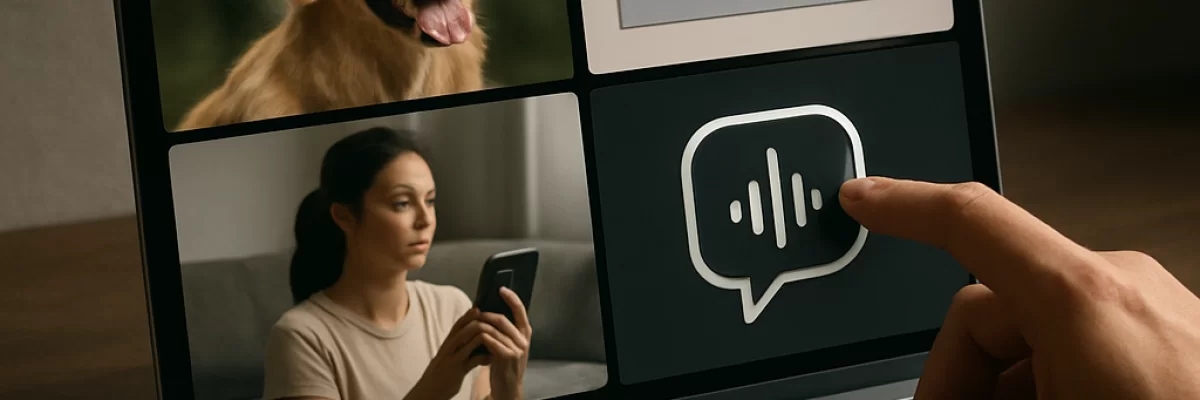
What is a multimodal AI model?
A multimodal AI model is a machine-learning model trained or designed to work with more than one kind of data. Common modalities include:
- Text
- Images and photographs
- Audio and speech
- Video
- Documents, diagrams, and charts
- Code
- Sensor or robotic data in specialized systems
A model can be multimodal in different ways. It may accept several kinds of input, generate several kinds of output, or do both. For example, a model might accept an image and a written question but produce only a text answer. Image input alone does not mean that the model can generate images.
The defining capability is cross-modal processing: relating information from different modalities. A system that reads a photograph and answers a question about it is doing more than processing two unrelated inputs.
Why multimodal models matter
Much of the information people use is not written as plain text. A business may store knowledge in scanned documents, spreadsheets, diagrams, recordings, product photographs, and videos. A multimodal model can make these sources easier to search, explain, and use.
Multimodal models can support tasks such as:
- Answering questions about charts, screenshots, and photographs
- Extracting information from forms, receipts, and other documents
- Transcribing and summarizing meetings or interviews
- Finding events in a video
- Searching an image catalog with text or photographs
- Providing accessibility descriptions for visual or audio content
- Supporting creative work involving images, audio, or video
- Helping robots and other embodied systems connect instructions with visual observations
They are useful because the input can more closely match the real problem. A user can show a damaged object rather than describe it, or submit a chart rather than manually type every value.
How multimodal AI models work
There is no single architecture used by every multimodal system. A model may be built as one unified system or assembled from several specialized components.
Separate encoders and adapters
One common design uses a specialized encoder for each modality. An image encoder converts visual information into a machine-readable representation, while a speech encoder processes audio. An adapter or projection layer then maps those representations into a form that another model can use.
In simple terms, the encoders turn different kinds of information into compatible internal representations. The model can then relate an image to a question, a transcript to a document, or a video event to a description.
Shared representations and cross-attention
Some systems place different modalities into a shared representation space. This makes it possible to compare or connect related content, such as a photograph and a text description.
Other systems use cross-attention, a mechanism that allows information from one modality to influence how another is processed. For example, a question can direct the model's attention toward a relevant region of an image.
Interleaved multimodal context
Some models process text, images, audio, or other inputs together in an ordered context. This allows a user to provide a sequence such as an image, a written explanation, another image, and a follow-up question.
The exact implementation is provider- and model-specific. A product may describe itself as multimodal even when the underlying application combines several specialized models rather than using one model for every task.
How multimodal models are trained
Training data can contain paired, synchronized, or interleaved examples. An image may be paired with a caption, an audio recording with a transcript, or video with descriptions of events over time.
Training objectives can include:
- Contrastive learning: bringing related text and visual or audio representations closer together
- Autoregressive prediction: predicting the next piece of a sequence
- Captioning and transcription: connecting media with textual descriptions
- Reconstruction: learning to recover or represent missing information
- Instruction following: learning to respond to questions and tasks involving multiple modalities
These methods help a model associate concepts across data types. However, training does not guarantee accurate perception. A model may still miss small text, misunderstand a chart, confuse speakers, or invent details.
Understanding and generation are different
Multimodal capability is not one feature. It is better understood as a set of input and output abilities.
- Image understanding: identifying or describing visual content
- Speech recognition: converting spoken audio into text
- Video understanding: analyzing scenes and events over time
- Image generation: creating or editing images
- Speech generation: producing spoken audio
- Video generation: creating or modifying video
A model may support one capability without supporting the others. A vision-language model that answers questions about photographs is not automatically an image generator, and a speech-to-text model is not automatically a voice assistant.
This distinction is also relevant to multimodal output. A system can accept multimodal input while returning only text.
Multimodal model, application, and tool: what is the difference?
The word “multimodal” can describe different layers of a system.
Multimodal model
The model itself is trained or designed to process multiple modalities, often within a shared interaction.
Multimodal application
An application may combine specialized components. For example, it could send an image to an OCR system, audio to a speech recognizer, and the resulting text to a language model. The complete application is multimodal even if the language model alone is not.
External tool
An assistant may call OCR, web search, image search, retrieval, or a separate media generator. Tool use can create a multimodal experience, but it is not the same as native cross-modal processing inside one model.
This distinction matters when evaluating a system. A feature shown in a product may depend on preprocessing, a separate service, or a particular endpoint rather than on the base model.
Examples of multimodal reasoning
Chart plus question
A user uploads a chart and asks which month had the steepest decline. The system must interpret the chart, read labels, identify values, and compare them. Errors can come from visual perception, missing labels, or the comparison itself.
Photograph plus troubleshooting
A user photographs a device panel and asks which indicator is abnormal. The system may need to recognize the panel, read small text, identify the relevant light, and explain what it might mean.
Audio plus summary
A meeting recording can be transcribed and summarized into action items. Noise, accents, specialist vocabulary, and overlapping speakers can affect the transcript and therefore the summary.
Video plus temporal question
A question such as “When does the person enter the room, and what happens afterward?” requires more than recognizing one frame. The system must analyze changes over time. Some systems sample frames and combine them with transcripts or audio, while others model temporal relationships more directly.
Cross-modal search
A retailer might search a catalog using either a written description or a photograph. A multimodal embedding model can map text and images into a compatible vector space so related items can be retrieved. An embedding model supports similarity and retrieval; it is not necessarily a conversational or generative model.
Important limitations
Multimodal models can be powerful, but additional modalities do not automatically make a system more accurate. Inputs may be noisy, contradictory, irrelevant, or misleading.
- Perceptual errors: Models may miss small objects, fine print, chart details, sounds, or brief events.
- Resolution and context limits: File size, image resolution, video duration, frame sampling, and context limits affect what the model can inspect.
- Uneven performance: A model may perform well on photographs but poorly on handwriting, diagrams, rare languages, specialized documents, or noisy audio.
- Temporal weaknesses: Video analysis may overlook changes between sampled frames or misinterpret the order of events.
- Hallucinations: A model may describe details that are not present or give an explanation unsupported by the input.
- Synchronization problems: Audio, video, and text may be poorly aligned, especially in long or complex recordings.
- Privacy and security risks: Media can contain faces, voices, documents, locations, personal information, or confidential business data.
- Cost and latency: High-resolution, long, or live media can require more processing than a short text request.
A multimodal model also does not automatically have live web access, persistent memory, or human-level perception. Uploaded content is normally part of the current request or conversation context unless an application separately stores information.
What to check before using one
Capabilities vary between models, products, plans, regions, and endpoints. Before relying on a multimodal system, verify:
- Which input and output modalities are supported
- Accepted file formats, sizes, resolutions, durations, and frame rates
- How video is sampled and whether audio is analyzed
- Context and tokenization limits for documents and media
- Whether the task requires a general model or a specialized OCR, speech, detection, retrieval, or document system
- Streaming, latency, and availability requirements
- Privacy, retention, access-control, and media-safety practices
For high-impact tasks, preserve provenance such as page numbers, image regions, timestamps, or source identifiers. Validate important extracted fields and use human review where errors could cause significant harm.
A simple way to experiment
Start with a chart, screenshot, or clear object photograph. Ask the model first to describe what it sees, then ask it to extract a specific fact, and finally ask it to explain a conclusion. Crop the relevant region and repeat the task to see whether additional focus improves the result.
For video, ask for timestamps and check the answer against the relevant frames. For audio, compare the transcript with the recording, especially when there is background noise or more than one speaker. Testing deliberately difficult examples is often more informative than testing only clear, simple inputs.
Related concepts
Multimodal AI overlaps with several related ideas. AI model evaluation helps measure whether a system is accurate and reliable. Model quantization can affect how models are deployed locally or on constrained hardware. The distinction between cloud and local AI models also matters when media is sensitive or when latency and hardware constraints are important.
The central lesson is that “multimodal” describes how a system works with different kinds of information, not a guarantee of quality. To evaluate a model properly, examine the exact modalities, inputs, outputs, processing limits, and safeguards available for the task you care about.